
This is not a pitchfork post
Writing about technology is always a trap. It is easy to sound like a doomsayer, shaking a fist at every new tool that disturbs old habits. That is not what this is.
I am not anti-technology. I am a nerd, a geek, and the kind of person who actually enjoys tools, systems, software, and strange little workflows that make life easier. I like good tools. I like elegant systems. I like the feeling of discovering something that removes friction from a task without removing the task’s meaning.
But I am also an educator, which means I see the other side of the machine every day. I see young people skip the slow work of learning because a tool can perform the school task for them. It gives the answer, but it does not transfer knowledge. It produces the product, but it does not make the learner more capable.
That is the problem I explored in my earlier essay, The Illusion We Call Intelligence: the danger is not only that AI can generate language. The danger is that we start mistaking generated output for understanding, convenience for learning, and fluency for thought. A student can submit a polished paragraph and still not know how to build one. A worker can produce a report and still not understand the judgment behind it. The surface improves while the inner ability weakens.
So this is not about hating technology. It is about asking what technology is not.
The video and the idea of “software brain”
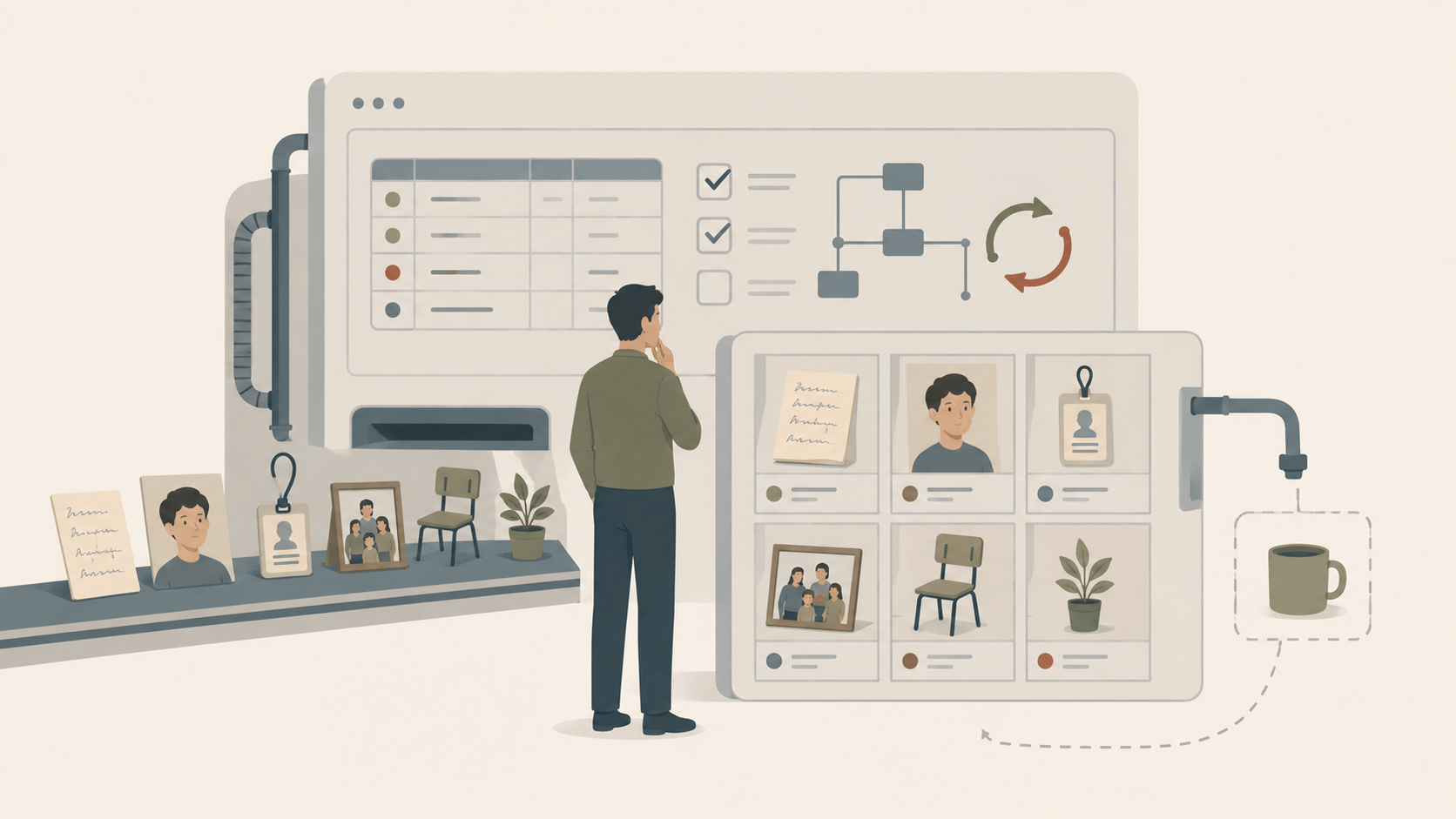
The main video behind this post is Nilay Patel’s Decoder episode for The Verge, “The People Do Not Yearn for Automation,” published on April 23, 2026. Patel is editor-in-chief of The Verge and host of the Decoder podcast. In the episode, he criticizes what he calls software brain: a way of seeing the world as databases, loops, inputs, outputs, and systems waiting to be automated.
Patel’s point is not simply that AI is unpopular. His argument is that the tech industry misunderstands why people dislike it. The industry keeps treating human life as if it can be made legible to software if only enough data is collected and enough loops are automated.
That may work for business processes. It does not work for life.
A business can turn inventory into a database. A delivery route can become an optimization problem. A customer support queue can be sorted, tagged, and routed. But human life is not only a queue. It includes hesitation, contradiction, private context, bad timing, silence, resentment, memory, and dignity. These do not fit neatly into a product roadmap.
Patel’s criticism matters because he is not only talking about AI. He is talking about a broader tech habit: the assumption that because something can be modeled in software, it should be redesigned around software. The result is a world where people are asked to become more machine-readable, more trackable, more predictable, and more available to systems that promise convenience.
People do not always reject technology because they misunderstand it. Sometimes they reject it because they understand what it is asking from them.
Why people distrust the tech industry
This connects directly to another video: “The AI industry is ignoring how much people hate it,” an episode of The Tech Report hosted by Isaac Pound and published on April 20, 2026. In it, Ed Zitron, author of Where’s Your Ed At and host of Better Offline, argues that the AI industry has spent years antagonizing the public and then acting surprised when people become angry.
Zitron’s point is blunt. People are already dealing with rising costs, job insecurity, housing pressure, healthcare costs, and general instability. Then AI leaders appear on stage and tell them that many jobs may disappear, that companies need huge data centers, that models are powerful and dangerous, and that all of this is inevitable.
From Zitron’s perspective, the mistrust is not mysterious. People hear threat, hype, and entitlement. They see companies asking for money, data, energy, legal freedom, and public patience, while offering vague promises about future abundance.
This is important because the industry often treats public anger as a communication problem. If only people understood AI better, the thinking goes, they would accept it. But trust is not only produced by explanation. Trust is produced by experience.
People have already experienced automated customer service that cannot help them, recommendation systems that manipulate attention, platforms that harvest data, and products that get worse after becoming unavoidable. They have watched tech companies promise openness, then build closed ecosystems. They have watched tools sold as empowerment become systems of surveillance, dependence, or cost-cutting.
Zitron also argues that AI companies should stop making models feel like human companions and start treating them like ordinary tools. That matters because anthropomorphic design can make people overtrust systems that do not understand them. A chatbot that says “I understand” may sound comforting, but it does not understand in the human sense. It predicts, responds, and continues the interaction.
That difference is not small. It is the difference between a tool and a relationship.
The disconnect is not accidental
The disconnect between people and tech happens because the incentives are different.
The industry sees automation, scale, efficiency, and market capture. Ordinary people see job risk, surveillance, degraded services, broken trust, and tools that often make them feel less human. A company may see a customer service bot as efficiency. The customer may experience it as being trapped in a loop with no one responsible on the other side.
This is why algorithm aversion makes sense. People may forgive human mistakes more easily than machine mistakes because human mistakes still feel accountable. A person can explain, apologize, improvise, or understand context. A system often cannot. One machine error can destroy trust because the user has no clear way to appeal to judgment.
And even when an automated system is statistically good, people may still resist it if it threatens autonomy, identity, or dignity. A worker may not hate the software because it is useless. They may hate it because it watches them. A teacher may not reject AI because it cannot produce text. They may reject it because students use it to bypass the thinking the assignment was meant to create.
That is where the conversation becomes more serious. The issue is not whether AI works. Sometimes it does. The issue is what kind of work it replaces, what kind of person it produces, and what kind of relationship it creates between humans and institutions.
The tech industry often treats distrust as irrational. It is not always irrational. Sometimes it is memory. People remember being automated out of care.
Work, identity, and education
AI will affect work. That much is certain. But it will not affect every country in the same way.
Each economy is built differently. Some depend heavily on services. Some depend on manufacturing, outsourcing, tourism, agriculture, remittances, public-sector employment, informal work, or small businesses. Populations also move differently. Young people migrate, reskill, resist, adapt, or leave entire sectors depending on local conditions.
So the impact of AI will not be one clean “world economy” story. It will be many national stories, each shaped by labor markets, education systems, regulation, wages, migration, and political choices. In one country, AI may threaten white-collar service jobs. In another, it may reshape outsourcing. In another, it may deepen the gap between people who can use the tools and people who are managed by them.
The same is true in education. If students use AI to skip practice, they may produce better assignments while becoming worse learners. This is not progress. It is outsourcing the struggle that builds skill. A tool that answers for the student does not automatically educate the student.
Learning requires friction. It requires the awkward attempt, the failed sentence, the unfinished thought, the correction, the second try. If a tool removes all of that, it may also remove the path through which competence forms.
Accessible intelligence sounds like a gift. But if it weakens judgment, lowers patience, replaces practice, and teaches people to trust fluent output without understanding it, it may create more problems than it solves.
What tech is not
Technology can extend human capacity. It can help us write, calculate, translate, organize, search, design, and build. It can make difficult work easier. It can open access where access was limited.
But technology is not meaning. It is not judgment. It is not trust. It is not education. It is not care. It is not the lived process through which a person becomes more capable.
That distinction matters because the AI conversation often blurs it. The product performs the visible task, so we pretend it has replaced the invisible process. It writes the paragraph, so we pretend it has learned. It answers the customer, so we pretend service has happened. It summarizes the meeting, so we pretend understanding has taken place.
This is the illusion. Not that the tools are useless, but that output is enough.
Watch the videos
This post only sketches the argument. Patel’s video is useful because it names the worldview behind the problem: software brain. Zitron’s interview is useful because it explains why public anger toward AI is not just fear of change, but a response to threats, hype, job anxiety, and mistrust.
And my own position, from The Illusion We Call Intelligence, is that we should stop confusing output with understanding. Technology should extend human capacity. It should not train us to abandon it.
Watch Nilay Patel’s Decoder episode, “The People Do Not Yearn for Automation,” here:
Watch Ed Zitron on The Tech Report, “The AI industry is ignoring how much people hate it,” here: