
Ordinary words are not ordinary
Some words look too small to notice.
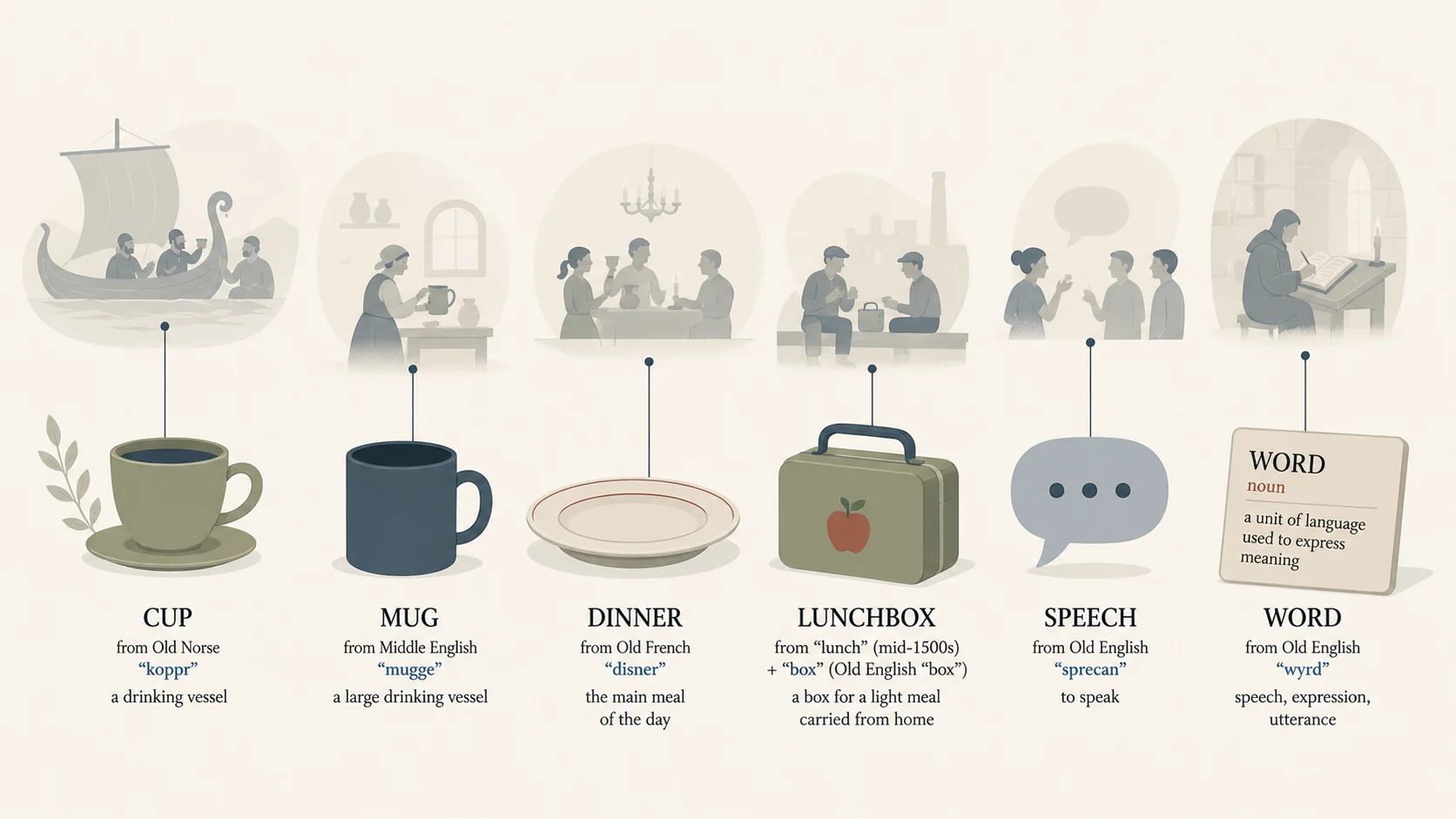
Cup. Mug. Lunch. Dinner. Among. Amongst. These are not rare words. They are not the kind of words that make people stop and say, “That sounds interesting.” But that is exactly why I like them. They sit quietly in ordinary speech, carrying histories we rarely think about.
A dictionary can tell us what a word means. It cannot always tell us what a word feels like in a room, in a family, in a region, or in a class situation. That is where usage becomes more interesting than definition.
This is not another post about whether English is correct, global, or grammatically flexible. I already touched on those questions in related pieces on grammar and meaning, correct English, and global English. Here, I want to look at something smaller: the way everyday words carry social memory without announcing it.
A cup is not only a cup
The difference between a cup and a mug looks simple. A cup is smaller, maybe finer. A mug is bigger, heavier, more practical. But the more you think about the words, the less physical the difference becomes.
A cup often sounds social. A cup of tea is not just tea in a container. It suggests a pause, a visit, a small ritual, maybe someone saying, “Come in, I’ll make tea.” The word points to the moment around the object.
A mug feels closer to use. It is the thing on a desk, beside a laptop, in a kitchen sink, held with one hand while doing something else. It does not ask for ceremony. It just works.
That difference still lingers. Even when the objects overlap, the words do not feel identical. A cup can suggest company. A mug can suggest routine.
Lunch, dinner, and the social clock
Meal names do the same kind of work.
For many people, lunch means the midday meal and dinner means the evening meal. But not everywhere. In some places and families, dinner is still the main meal of the day, even if it happens at midday. That is why phrases like school dinners still sound natural in some contexts.
This is not only about time. It is about region, class, routine, and family memory. Historically, dinner named the main meal. As habits changed, especially among people who ate later and treated the midday meal as lighter, lunch became stronger.
So a simple question like “What did you have for dinner?” can carry more than hunger. It can carry where someone is from, how their family speaks, and what kind of daily rhythm they grew up with.
A meal word is also a clock. Sometimes it is a household too.
Among, amongst, and the sound of formality
Some differences are almost invisible until someone reacts to them.
Among and amongst mean nearly the same thing, but they do not sound the same to everyone. For some speakers, amongst sounds formal, literary, British, old-fashioned, or slightly posh. For others, it may sound regional or completely normal.
The meaning does not change much. The social sound does.
That is what makes usage interesting. A word can bring a texture with it before the sentence is even finished. It can make a sentence sound plain, formal, local, distant, careful, old-fashioned, or intimate.
This is why “correct” is often the least interesting question. A better question is: what does this word do here?
Politeness changes shape
Even polite expressions have histories.
You’re welcome may sound like a standard response to thank you, but it did not begin only as a modern service phrase. Its older sense is closer to hospitality: you are welcome here, you are received, you are accepted. Over time, that sense moved into the smaller exchange of thanks and response.
The phrase stayed, but its job changed.
I like this example because it shows how language often changes quietly. Words do not always disappear and get replaced. Sometimes they remain in place while their function shifts. A greeting becomes a formula. A formula becomes automatic. But somewhere inside it, an older social gesture is still hiding.
Slang appears quickly, but most of it disappears
Not every new word survives.
English produces new expressions constantly, especially online. Some enter common use. Many disappear quickly. Slang is useful because it marks belonging, speed, mood, and moment. But that same usefulness can make it temporary. A word that feels alive because it belongs to now may lose its force when now has moved on.
This is one reason counting English words is so difficult. The language is not only made of stable dictionary entries. It is also made of compounds, technical terms, regional expressions, jokes, temporary slang, and words that live intensely for a short time before vanishing.
A language is not a museum. It is traffic.
What small words reveal
The secret life of English words is not hidden only in rare vocabulary. It is often in the words people use every day.
A cup carries ritual. A mug carries use. Lunch and dinner carry time, class, and region. Amongst carries a social tone that among may not. You’re welcome carries an older idea of hospitality inside a modern polite exchange.
That is why small words are worth looking at. They show that language is never only a system of meanings. It is also a record of how people live together. It stores habits, divisions, gestures, preferences, and memories.
A word is never just a word.
It is a small piece of social history that people keep speaking.
Related Readings
Grammar Is What Turns Words Into Meaning
Source Note
Sources used: This post is mostly based on my David Crystal notes on English usage, variation, social meaning, and word history, narrowed here to ordinary words such as cup, mug, lunch, dinner, among, amongst, and you’re welcome.