

English did not become global because it was easy
There is a common explanation for the spread of English: it became global because it is simple. The idea is convenient. English has no grammatical gender for most nouns. Its basic sentence order is easy to recognize. Its verbs look lighter than those of many other languages.
But that explanation does not survive much contact with the language itself.
English is not simple. Its spelling often disagrees with its pronunciation. Its grammar has exceptions that feel normal only because speakers have repeated them for centuries. Its vocabulary is enormous, uneven, and full of near-synonyms that do not mean exactly the same thing. English became global not because it was easy, but because history made it useful.
Its spread came through empire, trade, migration, education, science, technology, cinema, business, and the internet. Once English reached new places, it did what it has always done: it absorbed, adjusted, and kept moving. That is the paradox of global English. It is difficult, but useful. Irregular, but flexible. Built through power, but reshaped by the people who use it.
A language built by taking things in
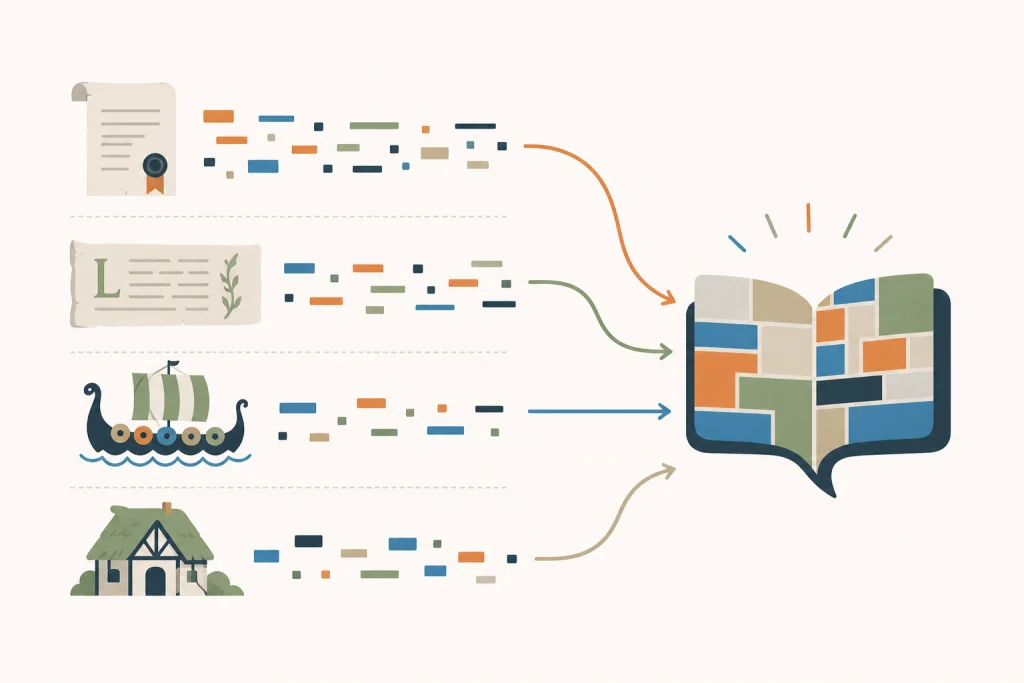
English did not grow by staying pure. It grew by borrowing.
Its base is Germanic, shaped by Anglo-Saxon roots. Many of its most common words still come from that older layer: house, fire, king, ask, bread, water, mother. These words feel direct because they sit close to everyday life.
Then came contact. Latin entered through religion, learning, and Roman influence. Old Norse arrived with Viking settlement and gave English words such as take, get, and egg. The Norman Conquest of 1066 brought French into the language of law, power, court life, and administration.
The result was not replacement. It was layering.
English kept older Germanic words while absorbing French and Latin vocabulary. This is why English can offer several words for the same idea, each with a different tone. We can ask, question, or interrogate. A ruler can be kingly, royal, or regal. A place can be a house, a mansion, or a residence.
These are not perfect duplicates. They carry history. Germanic words often feel plain and close. French-derived words often sound formal or elegant. Latin-derived words often feel technical, official, or abstract. English vocabulary became a system of choices, not just a list of meanings.
The size of English creates friction
One difficulty with English is that nobody can say exactly how many words it contains. Dictionaries record hundreds of thousands of entries, but they cannot capture every scientific term, regional expression, slang phrase, compound, technical word, or online invention.
English is especially good at making new combinations. A phrase like heart-friendly, climate-conscious, or red-wine-is-best theory may not appear in a dictionary, but a speaker can understand it. The language allows meaning to be built on the spot.
That flexibility is useful, but it also creates pressure. A learner may understand many words without feeling confident enough to use them. Recognition is easier than production. Passive vocabulary is larger: the words we understand when reading or listening. Active vocabulary is smaller: the words we actually use when speaking or writing.
This is why English can feel crowded. It gives speakers many ways to say almost the same thing, then asks them to choose the word that fits the tone, context, and audience.
English grammar is not as simple as it looks
English grammar looks simple from a distance. Up close, it becomes less predictable.
Articles are a good example. Learners are told that knowledge is uncountable, so we say knowledge, not a knowledge. Then they meet a phrase like a good knowledge of English, where the word behaves differently because it has been modified. The rule is not useless, but it is incomplete.
Contractions create similar trouble. The form amn’t I would seem logical, and it exists in some varieties of English, but Standard English usually says aren’t I. Grammatically, this is strange. Socially, it is accepted.
Then there are the rules that are really habits. Many students are told not to begin a sentence with and or but. Yet writers use both for rhythm, contrast, and force. The question is not only whether a form is allowed. The question is whether it works.
English is full of this tension. It has rules, but it also has usage. It has logic, but it also has history. Sometimes the real explanation is not “because grammar says so,” but “because speakers made it normal.”
Speech, writing, and the useful mess
Another source of difficulty is the gap between spoken and written English. Speech moves quickly. It drops sounds, bends grammar, depends on rhythm, and relies on shared context. Writing is slower, more controlled, and more exposed to correction.
This gap creates small decisions everywhere. Should it be geographic or geographical? -ise or -ize? Where does the apostrophe go? Why does spelling preserve traces of sounds that speech no longer uses?
English also stretches forms easily. The suffix -ish is a good example. It can describe color, time, mood, certainty, or approximation: greenish, sevenish, tiredish, formal-ish. It lets speakers avoid precision without losing meaning.
This looseness is one reason English travels well. It can be formal, technical, casual, playful, local, or international. But the same looseness makes it hard to standardize. English is not a fixed object. It is a set of moving habits.
Global English is not one English

The spread of English did not produce one single version of the language. It produced many Englishes.
Caribbean English, Indian English, Nigerian English, Singapore English, Moroccan classroom English, American English, British English, and digital Englishes all show how the language adapts to local realities. New words enter. Old words shift. Accents change. Grammar bends. Expressions move from one place to another.
This is not decay. It is how living languages behave.
A global language cannot remain untouched. The more people use it, the less it belongs to one center. English may have spread through power, but it now survives through adaptation. It is shaped by native speakers, second-language speakers, teachers, students, migrants, programmers, artists, and online communities.
The internet has accelerated this process. Digital spaces expose users to different dialects, abbreviations, jokes, mistakes, corrections, and inventions every day. English online is not controlled by one authority. It is negotiated in public, in real time.
Power made English useful
English dominates because power made it useful.
The British Empire carried it across continents. The rise of the United States strengthened it through business, science, diplomacy, entertainment, computing, and academic publishing. Aviation, software, pop culture, and the internet reinforced its position.
Once a language becomes globally useful, it becomes self-reinforcing. People learn it because it opens doors. Institutions use it because people know it. Companies require it because markets expect it. The cycle continues.
This does not mean English is better than other languages. It means English became attached to systems of power. Its global status is not proof of linguistic superiority. It is the result of history.
The paradox remains
English is powerful because it is everywhere, but it is everywhere because power carried it there. It is useful because so many people use it, but so many people use it because they have had to. It absorbs easily, but that same absorption makes it irregular and difficult.
This is the paradox of global English.
It is not simple, but it is practical. It is not pure, but it is rich. It is not neutral, but it is shared. It can exclude, but it can also connect. It carries the history of empire, but also the creativity of the people who adapted it and made it their own.
English did not become global because it was easy. It became global because history made it powerful, and people made it useful.