
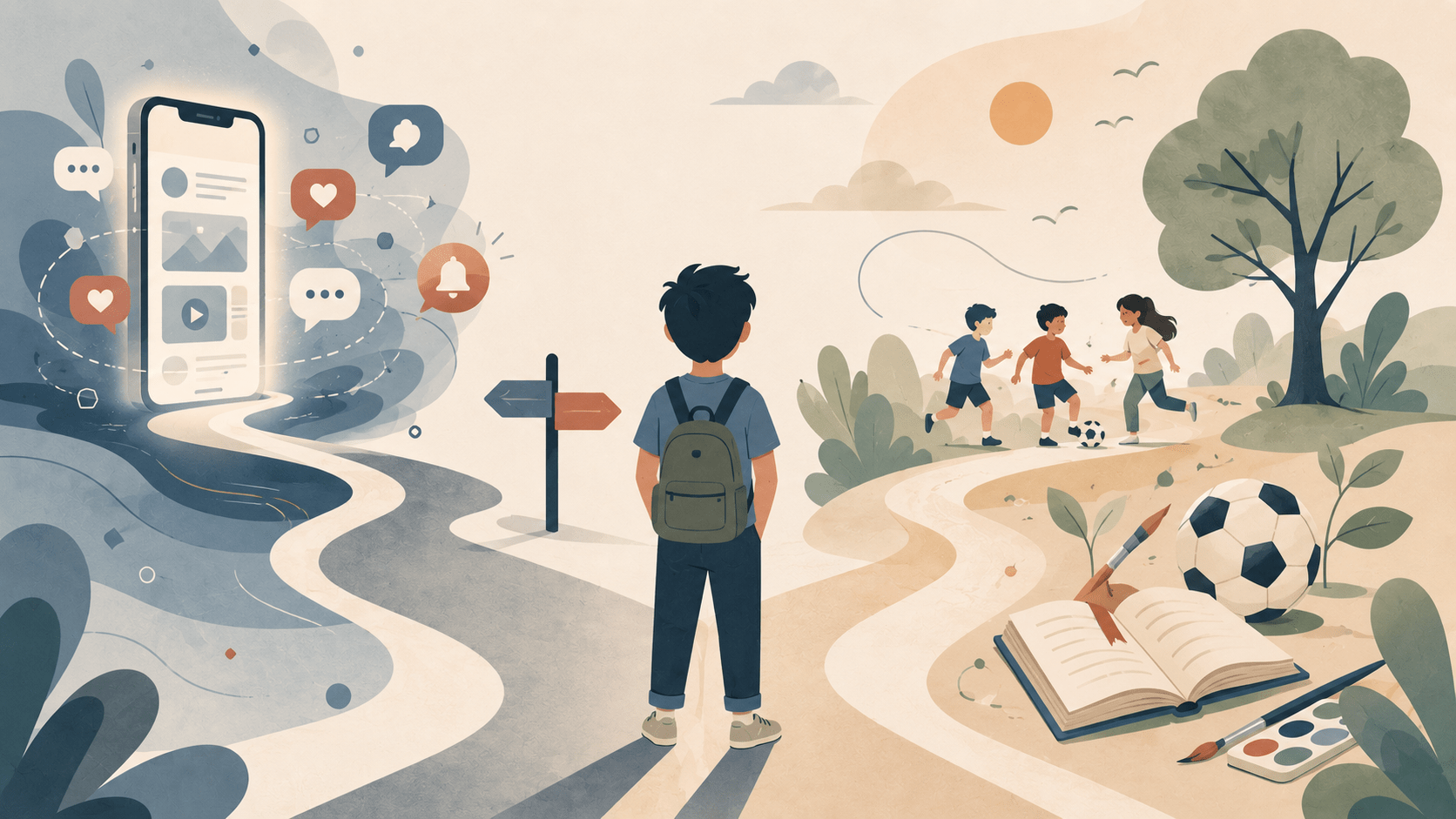
From school phone bans to something bigger
In a previous post, I argued that school phone bans are not a magic fix for the attention problems many schools are dealing with.
Taking phones out of classrooms can help. Lessons are usually calmer when students are not checking notifications every few minutes. But the classroom is only one part of a much bigger picture. By the time children arrive at school each morning, their relationship with technology has already been shaped by home life, online habits, and the culture around them.
The UK’s proposed restrictions on social media use for under-16s take the conversation beyond schools and ask a different question: should children have access to some of these platforms at all?
It’s not a surprising question. Concerns about social media have been building for years. Parents worry about anxiety and sleep. Teachers talk about attention and distraction. Researchers debate the effects of endless scrolling, algorithmic feeds, and constant comparison. Even many adults admit they struggle to manage their own use.
Against that backdrop, restricting access can seem like common sense.
But common sense solutions are not always complete solutions.
If children spend less time on social media, where are they supposed to go instead?
Why the idea is appealing
Part of the appeal is its simplicity. It creates a clear rule and sends a clear message.
Parents no longer have to negotiate every platform individually. Schools receive stronger backing. Platforms are pushed to take child safety more seriously instead of relying on optional settings and parental controls that many families never use.
The proposal focuses on major social media platforms used by under-16s, including TikTok, Instagram, Snapchat, YouTube, Facebook, and X. Messaging services such as WhatsApp and Signal, educational tools like Google Classroom, and platforms such as YouTube Kids would be exempt. It also includes stronger age assurance requirements, enforcement powers for Ofcom, and significant fines for companies that fail to comply. Additional measures would restrict livestreaming, communication with strangers, certain gaming features, and some AI chatbot functions.
It’s easy to see why many people support that approach.
For years, most of the responsibility has fallen on parents and schools. Parents are expected to manage devices. Teachers are expected to deal with the consequences. Meanwhile, platforms are designed to keep people engaged for as long as possible.
Parents can set boundaries. Schools can set rules. Neither can redesign TikTok.
That is why the debate has shifted. More people are asking whether families and schools should carry the burden alone when so much of the environment is shaped elsewhere.
The limits of banning access
At the same time, it’s worth being realistic about what restrictions can and cannot do.
Anyone who has spent time around teenagers knows that rules rarely end a behaviour completely. They change it.
Some children will follow the rules. Some will not. Some will find ways around them.
VPNs, borrowed accounts, fake birthdays, alternative platforms, and private groups will become part of the landscape. That doesn’t mean restrictions are pointless. It simply means they create friction rather than perfect control.
There is also the question of privacy.
Age verification sounds straightforward until you ask how it actually works. Facial age estimation, digital IDs, and other verification systems all require some form of personal data. The more aggressively age is verified, the more questions arise about surveillance, accuracy, and data security.
Those concerns deserve to be taken seriously.
A policy can be well-intentioned and still create new problems. Children may be pushed toward less regulated spaces. Privacy may be weakened in the name of protection. Systems designed to keep people safe may make mistakes or exclude people unfairly.
The real test is not whether a restriction sounds sensible. It’s whether it improves the situation in practice without creating equally serious problems elsewhere.
The real issue isn’t screen time
One reason these debates often go in circles is that people talk about screens as if all screen use is the same.
It isn’t.
A teenager watching a tutorial, chatting with friends, creating art, reading an article, scrolling through conspiracy theories, and spending hours trapped in an algorithmic feed are all technically using a screen. But those experiences are very different.
The deeper issue is not screens themselves. It’s the attention economy.
Most major platforms are built around the same goal: keeping users engaged. Notifications, recommendations, autoplay, streaks, infinite scrolling, and personalised feeds are not accidents. They exist because attention has value.
For adults, that environment can be difficult enough to navigate.
For children, it’s even harder.
Young people are still learning how to regulate impulses, manage emotions, and understand persuasion. Yet they are growing up inside systems specifically designed to compete for their attention.
That is why the conversation cannot stop at screen time.
The more important question is what kinds of digital environments children are spending time in and how those environments shape behaviour.
The part that matters most
What interests me most is not the restriction itself but what comes alongside it.
The Every Child Can programme includes £132.5 million for sports, arts, nature, and community activities. That matters because it recognises something many debates about technology overlook: children need alternatives.
If we want children to spend less time online, we need to give them somewhere else to be.
Of course, that is easier said than done.
The platforms being targeted have enormous resources, global reach, and years of experience competing for attention. Community programmes are trying to fill a gap created by systems operating on a completely different scale.
Still, the principle is important.
Restrictions can remove something. They cannot automatically replace it.
Sports clubs, youth groups, libraries, creative programmes, outdoor activities, and community spaces offer more than something to do. They create friendships, routines, confidence, and a sense of belonging. Over time, those experiences can become part of everyday life in the same way constant connectivity gradually became part of everyday life.
The real challenge is not introducing a restriction.
It’s helping a different culture take root.
Schools cannot carry the whole burden
This brings me back to school phone bans.
Part of me welcomes proposals like this because they finally acknowledge something schools have been saying for years: schools cannot solve this problem alone.
Schools often sit at the centre of these debates because they are where the consequences are easiest to see. Teachers watch attention drift. School leaders deal with behaviour issues. Staff spend time managing conflicts that started online and followed students into the classroom.
But schools didn’t create the systems behind those problems.
They’re dealing with the fallout.
A school can ban phones during lessons. A government can restrict access to social media. A regulator can fine companies.
In that sense, moving responsibility beyond the school gates feels overdue. If platforms help create the problem, then they should carry some responsibility for it.
At the same time, I’m sceptical of the idea that bans are solutions in themselves.
Children still need to learn how to handle boredom, build friendships, resolve disagreements, and focus on things that don’t provide instant rewards. Those skills develop through family life, friendships, communities, schools, and everyday experiences.
When children have fewer opportunities for independent play, fewer safe places to spend time, fewer community activities, and constant access to digital entertainment, schools inevitably end up carrying responsibilities that extend far beyond education.
That is why I hesitate whenever restrictions are presented as transformative solutions.
They may reduce harm. They may support parents. They may encourage platforms to take child safety more seriously. Those are worthwhile outcomes.
But much of the discussion still focuses on limiting access rather than rebuilding the conditions that made screens so dominant in the first place.
Restriction versus restoration
Restrictions also have a political advantage: they are visible.
A government can announce a ban. A regulator can introduce new rules. Companies can be fined. Headlines can be written.
Visible action creates the feeling that something is being done.
Sometimes that matters. Sometimes it genuinely helps.
But visible action can also create a false sense of completion.
Stopping children from entering one space is not the same as giving them somewhere better to spend their time.
A more honest conversation would acknowledge that several things can be true at once.
Some social media platforms are clearly designed in ways that are unhealthy for children. Restrictions and safeguards can provide meaningful protection. Age verification raises legitimate privacy concerns. Not every digital space is equally harmful. Many young people use online communities for learning, creativity, support, and connection.
And regardless of what happens online, children need richer offline lives.
For years, technology companies have benefited from systems built around maximising engagement. When concerns emerge about the effects of those systems, responsibility often shifts to parents, teachers, and governments.
That arrangement is becoming harder to defend.
If platforms play a role in shaping children’s behaviour, attention, and wellbeing, then they should bear some responsibility for the consequences. But responsibility should not stop there. Communities, schools, families, and governments all have a role in creating environments where children have meaningful alternatives to constant digital stimulation.
The UK’s proposed social media restrictions matter because they signal a shift in how the problem is understood. The conversation is no longer focused only on parental responsibility or school discipline. Increasingly, it is about the role platforms play in shaping childhood itself.
That is an important shift.
But the lesson from the school phone ban debate still applies.
Reducing access is not the same as rebuilding attention.
Restricting social media is not the same as restoring childhood.
The long-term answer is unlikely to come from a single ban, a single age check, or a single piece of legislation.
Restrictions may be part of the response. They may reduce harm and create healthier boundaries. But they will never be enough on their own.
The harder task is creating a world that offers children something genuinely worth choosing over the endless pull of the feed.
That work is slower.
Less dramatic.
And probably where the real solution lies.
Sources used:
- NBC News reporting on UK Prime Minister Keir Starmer’s announcement of a forthcoming under-16 social media ban and restrictions on AI chatbot access: https://www.nbcnews.com/world/united-kingdom/keir-starmer-social-media-restrictions-rcna350037.
- BBC News coverage of the proposed inclusion of platforms such as YouTube and TikTok: https://www.bbc.com/news/live/c77yx1jpg1nt.
- New York Times reporting on the UK move following Australia’s sweeping social media ban introduced in December 2025: https://www.nytimes.com/2026/06/15/world/europe/uk-social-media-children.html.
- NPR reporting on similar measures being adopted or pursued in countries including Canada, Brazil, Indonesia, France, Spain, Denmark, Thailand, and South Korea: https://www.npr.org/2026/06/15/nx-s1-5858644/britain-social-media-ban.
- The Guardian’s reporting on implementation challenges, including privacy and security concerns around age verification: https://www.theguardian.com/uk-news/2026/jun/15/uk-under-16s-social-media-ban-how-will-it-work.
- Additional Guardian reporting on the government’s plan to task Ofcom with conducting a rapid study into age-assurance methods ahead of a spring 2027 implementation framework: https://www.theguardian.com/uk-news/2026/jun/15/uk-under-16s-social-media-ban-how-will-itwork