
The problem with bans
Schools have always tried to solve problems by banning things: clothes, snacks, slang, games, behavior, hairstyles, devices. Sometimes a ban helps. Sometimes it only moves the problem somewhere else. And sometimes it creates a new problem: resistance.
That is the first thing worth remembering about school phone bans. There will be friction. Students will push back. Some will find a way around the rule. Others will follow it but resent it. The more personal the object, the stronger the reaction.
A phone is not just an object anymore. For many students, it is communication, entertainment, identity, escape, status, and comfort packed into one rectangle. So when a school locks that rectangle away, even for good reasons, the reaction should not surprise anyone.
What the study actually shows
The research on lockable phone pouches gives a more complicated answer than either side usually wants.
The study looks at U.S. schools using lockable pouches, especially Yondr-style systems. Students keep their phones with them, but the phones stay locked during the school day. This is stricter than the usual “keep it in your bag” rule, which often depends on teachers constantly policing hidden use.
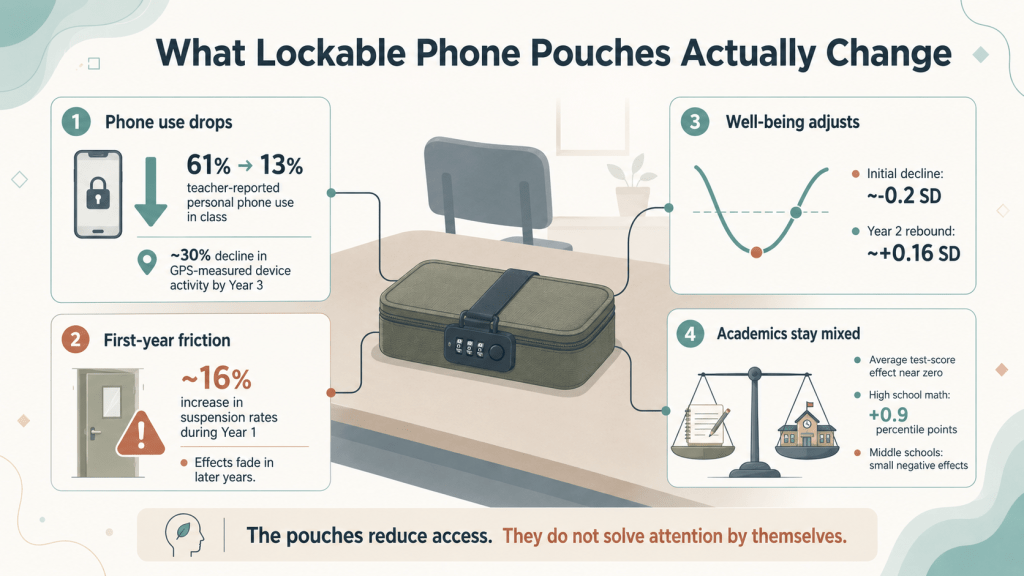
On the basic question, the pouches work. Teacher reports show personal phone use in class dropping from 61% to 13%. GPS data also suggests a meaningful decline in in-school device activity over time. So if the goal is simply to reduce access to phones during school hours, lockable pouches do that.
But the rest is not as clean.
The first year brings disruption. Suspension rates rise by about 16%. Student well-being drops at first. The likely explanation is not mysterious: a strict new rule creates more violations, more monitoring, more confrontations, and more frustration. Students lose access to something they are used to having, and schools have to enforce the loss.
Later, things improve. The disciplinary spike fades. Student well-being rebounds by the second year. Teachers become much more satisfied with the phone policy. But academic results remain mixed. Average test score effects are close to zero. High schools see modest gains, especially in math. Middle schools show small negative effects.
That is the uncomfortable finding: the ban works, but not in the simple way people want it to work.
The answers are smaller than the problem
This is where the conversation becomes frustrating.
The public conversation often wants direct answers. Will this help students focus? Will it improve grades? Will it reduce anxiety? Will it reduce bullying? Will the classroom feel calmer?
The research does give answers, but only within the limits of what a school-based study can measure. It can tell us what happens when phones are locked away during the day. It can track phone use, discipline, well-being, test scores, and teacher satisfaction. What it cannot do is solve the larger digital culture that students live in before and after school.
The clearest answer is this: phone pouches reduce phone use. They may improve well-being over time. They do not produce a dramatic academic miracle. They do not clearly improve attendance, classroom attention, or reduce bullying. They create short-term friction before any longer-term benefit appears.
That is not a useless result. It is a limited result, and that limitation matters. If the problem begins before students enter the classroom, then schools are not the original cause. They are the institution forced to deal with the consequences when those habits start damaging learning, attention, and classroom life.
The U.S. study still matters elsewhere
This study is based on U.S. schools, but the findings travel easily.
Students in Morocco, France, the UK, South Korea, or almost anywhere else are not living in completely different digital worlds. The platforms are global. The habits are global. The phone as an emotional object is global. The classroom struggle is also familiar: teachers trying to create attention in a world built to destroy it.
That world is not neutral. Every app on the device competes for attention because attention is how many of them make money. Notifications, streaks, feeds, likes, recommendations, short videos, private messages, and algorithmic nudges are not accidental distractions. They are part of an economy built to keep users returning. A teacher trying to hold a class together is not only competing with a phone. They are competing with an entire attention industry.
This is why the issue connects to ideas I explored in earlier posts such as Dangerous Apps and the Invisible Market Inside Your Phone and The Business Model of Modern Loneliness. The phone is not just a device students bring to school. It is an entry point into markets that monetize attention, loneliness, insecurity, boredom, and social pressure. A pouch can block access during the school day, but it cannot erase the design logic students return to after school.
Of course, schools differ. Rules differ. Families differ. Enforcement differs. But the basic conflict is recognizable almost everywhere: adults want school to protect attention, while students live in a culture that has already trained attention to fragment.
That is why the findings matter beyond the U.S. They show the limits of a school-only solution.
Schools cannot fix what society keeps feeding
My opinion is simple: schools cannot do this alone.
If parents put phones and tablets in front of toddlers, the shift has already happened before school begins. If children learn early that boredom should be killed instantly, that silence should be filled, and that discomfort should be interrupted by a screen, then schools inherit the outcome.
By the time a student reaches middle or high school, the phone is not just a distraction. It is part of how they regulate emotion, socialize, avoid awkwardness, escape boredom, and feel connected. Taking it away during the school day may help, but it also exposes how dependent the student has become.
That dependency was not created by one school policy, and it will not be undone by one pouch.
This is why typical solutions often disappoint. Adults look for a rule because rules feel actionable. Buy the pouches. Lock the phones. Announce the policy. Enforce the consequences. The school looks serious. The problem looks handled.
But attention is not restored by hardware alone.
What schools should learn from the findings
The lesson is not “phone bans are useless.” That would be too easy.
The lesson is that phone bans are a tool, not a cure. They can create the conditions for better attention, but they cannot guarantee better learning. They can reduce the visible distraction, but they cannot automatically teach self-regulation. They can make classrooms less phone-dominated, but they cannot repair the habits students bring from home.
Schools that adopt these policies should expect resistance. They should prepare for the first-year disruption instead of treating it as failure. They should be especially careful with younger students, who may replace phone use with other disruptive behavior. They should also explain the policy clearly, not as punishment, but as an attempt to protect the classroom from a device designed to compete with it.
And parents should not outsource the whole problem to schools.
A school can lock a phone during class. It cannot rebuild a child’s relationship with attention if every other space rewards distraction.
What remains
The research gives us a murky but useful picture.
Phone bans using lockable pouches reduce phone use. They make teachers happier with the classroom environment. They may help student well-being after an adjustment period. But they do not magically raise test scores, end bullying, fix attention, or undo years of digital conditioning.
That should make us more honest.
The problem is not only phones in schools. It is phones in childhood, phones in families, phones at dinner, phones before sleep, phones as babysitters, phones as comfort, phones as escape.
Schools can draw a line during the day. That may be necessary.
But society created the habit. Schools are only trying to manage the consequences.
Source Note
Sources used: This post comments on NBER Working Paper 35132, The Effects of School Phone Bans: National Evidence from Lockable Pouches,
Source: https://www.nber.org/papers/w35132