
The Answer Is the Moment in Front of You
The emperor wants certainty
Leo Tolstoy’s Three Questions is a short moral story about an emperor who wants to know how to live without making the wrong decision. It is simple on the surface: a ruler asks three questions, receives many answers, visits a hermit, and learns through what happens there. But the story is not really about advice. It is about the limits of advice when life refuses to arrive in a predictable form.
The emperor’s questions are easy to understand. He wants to know the right time to act, the right people to rely on, and the right thing to do. He believes that if he could answer these three questions, he would never fail in any matter.
The wish is not foolish. It is deeply human. Most people want some version of the same thing: a method that prevents regret, a plan that protects them from mistakes, a way to know the right action before the consequences arrive.
So the emperor asks his questions publicly and promises a reward. Advisers come with systems. Some recommend strict planning. Others tell him to remain constantly alert. Some say he needs councils of wise men. Others point to priests, physicians, warriors, science, religion, or prediction.
Each answer contains a partial truth. Planning matters. Attention matters. Advice matters. Knowledge matters. But none of these answers satisfies him because each one treats life as if it can be solved in advance.
What the emperor really wants is control.
Why the answers fail
The answers fail because they assume that life can be managed from a distance.
A schedule may organize time, but it cannot know what will interrupt it. A council may offer advice, but it cannot stand inside the exact moment where a decision has to be made. Prediction promises certainty, but life has a way of arriving through people and events no prediction fully contains.
The emperor senses this weakness. The answers are not useless, but they are incomplete. They speak as if the future were a problem to be mastered before it happens. Tolstoy’s story moves in another direction. It suggests that the meaning of action is often revealed only inside the situation itself.
That is why the emperor goes to the hermit.
The hermit refuses theory
When the emperor reaches the hermit, he expects wisdom in the form of an answer. Instead, he finds an old man digging.
The emperor asks his three questions, but the hermit does not respond directly. He continues working. He is tired. The work is difficult. The emperor sees this and takes the spade from him.
This silence is not empty. It is the beginning of the answer.
The hermit refuses to give the emperor another theory because theory is exactly what has failed him. Instead, he places him in a situation where he must decide what to do without certainty. The emperor can leave, demand an answer, or help the person in front of him.
He helps.
At first, this looks like a delay. In reality, it is the lesson taking shape.
The answer arrives as an interruption
Then the story changes.
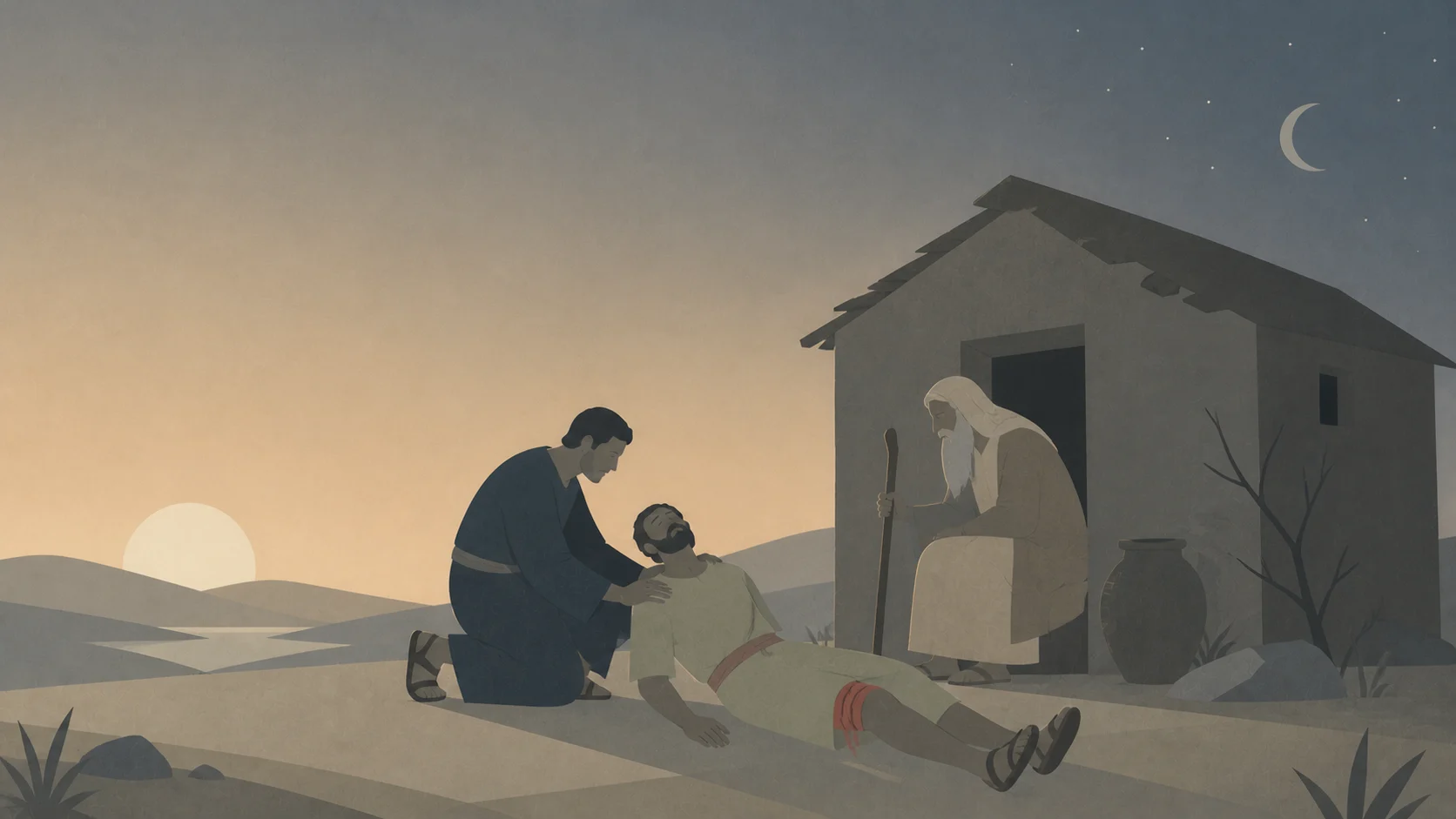
A wounded man runs out from the woods, bleeding heavily, and collapses near the hermit’s hut. The emperor stops asking questions. He cleans the wound, tears his own clothing to bandage it, brings water, and stays through the night.
Nothing about this was planned. The emperor did not climb the mountain to save an enemy. He did not know that staying with the hermit would keep him away from an ambush. He did not know that the wounded man had come to kill him.
But this is the point.
The most important action in the story does not come from certainty. It comes from attention. The emperor does the necessary thing before he understands its full meaning.
Only afterward does the pattern become visible. If he had left earlier, he would have been attacked. If he had ignored the wounded man, the man would have died, and the emperor would have lost the chance to turn an enemy into an ally.
The answer was not hidden in an idea. It was hidden in the moment he almost treated as an interruption.
The present is not a slogan
The hermit later explains that the emperor’s questions have already been answered.
When the emperor was digging, the most important time was that time, the most important person was the hermit, and the most important action was to help him. Later, when the wounded man appeared, the most important time became the time spent caring for him, the most important person became the wounded man, and the most important action became saving his life.
This can sound simple if it is reduced to a moral slogan: live in the present, help the person in front of you, do good now.
But Tolstoy’s story is more precise than that.
The emperor does not learn that planning is useless. He learns that no plan can replace attention. He does not learn that every person is equally important in the abstract. He learns that importance appears through encounter. He does not learn that action is always obvious. He learns that the right action is often the one demanded by the person and moment directly before him.
The present matters because it is the only place where action is possible.
Meaning comes afterward
One of the quietest truths in the story is that the emperor acts before he understands.
He does not know the consequences while he is digging. He does not know the wounded man’s identity while he is treating the wound. He does not know that mercy will become reconciliation. The meaning of his actions appears only afterward.
This is uncomfortable because we often want meaning before action. We want to know whether something will matter before we give ourselves to it. We want the certainty of importance before we commit.
Tolstoy reverses that order.
The emperor discovers importance by acting. He does the work, stays with the situation, responds to need, and only later sees what the moment contained. The story does not reward prediction. It rewards presence.
What the story rejects
Three Questions rejects the idea that importance can be assigned ahead of time with complete confidence.
We cannot always know which moment will matter. We cannot always know which person will change the direction of events. We cannot always know which action will carry consequences beyond what we can see.
This does not mean all planning is useless. It means planning has limits. Life is not a fixed schedule waiting to be managed correctly. It is a series of encounters that demand attention.
The emperor begins by asking how to avoid mistakes. By the end, he receives something better: a way to live without needing full control.
What remains
Tolstoy does not give the emperor abstract advice. He gives him a day.
An old man digging. A tired body. A wounded enemy. A night of care. A morning of forgiveness. Only after all this does the lesson become clear.
The most important time is not a perfect future moment we are waiting to identify. It is the moment in which we can act. The most important person is not an ideal figure chosen in advance. It is the person whose life has crossed ours now. The most important action is not the grandest plan. It is the help that the present asks from us.
The emperor wanted answers that would let him master life before it happened. Tolstoy gives him something humbler and more demanding: attention to what is already happening.
That is why the story lasts.
It does not tell us to control time, people, and action.
It tells us to meet them.