
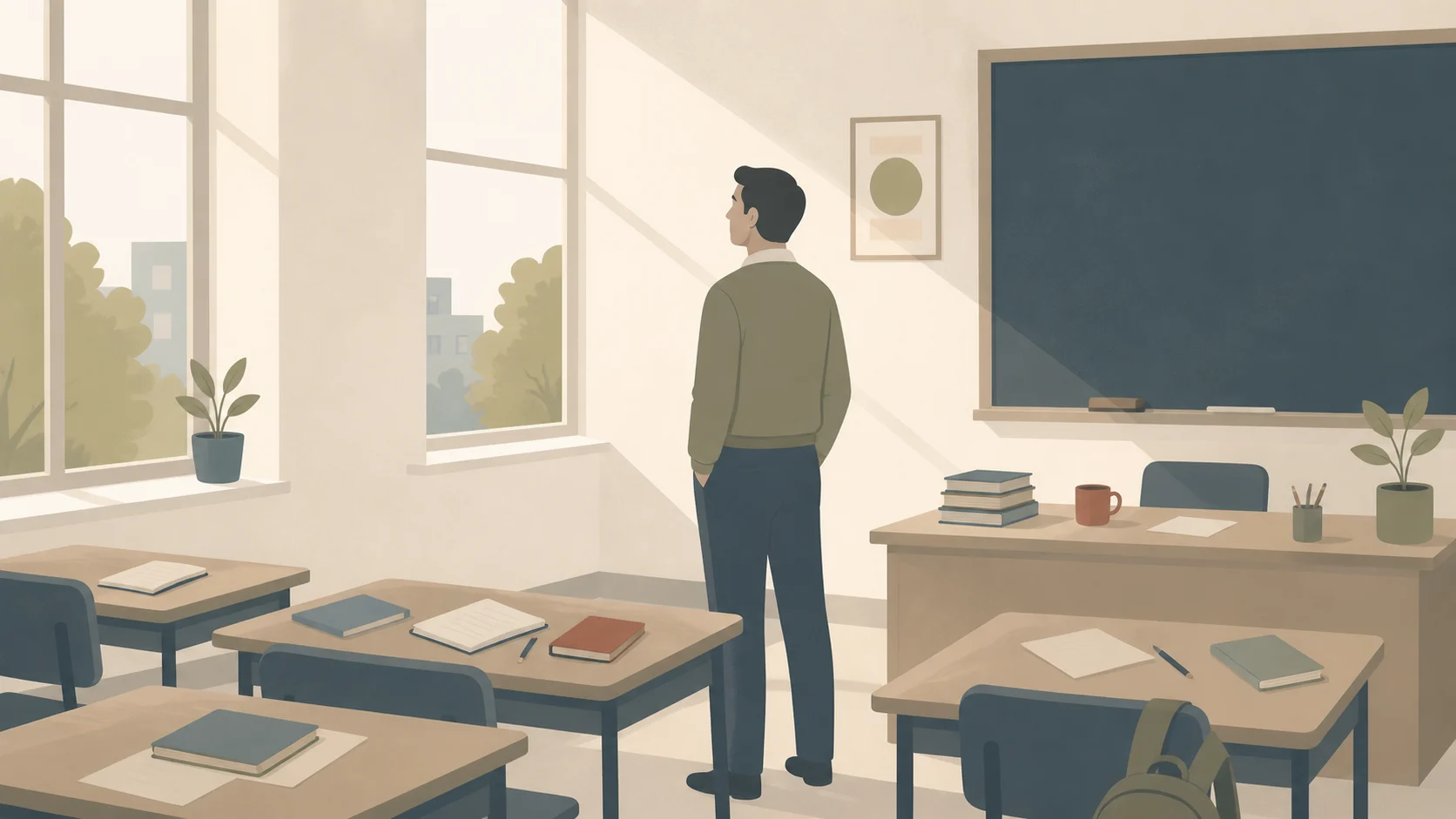
The question is not as simple as it sounds
At some point, every teacher is expected to answer the question: Why are you a teacher? It sounds simple, almost harmless. People usually expect a clean answer about passion, purpose, influence, or love for the profession. They expect the kind of answer that fits neatly into a training assignment, an interview, or a short personal statement.
But the question of why I chose to be a teacher feels disingenuous at times. The answer cannot be completely cynical, even if cynicism would be honest. It would feel awkward. And one hundred percent honesty is not always the best communication strategy with emotional beings.
The only option left is a bloated truth, with its rougher edges sugarcoated.
This is not a comprehensive view of the world of teachers. It is not an attempt to justify an imbalanced attitude. It is simply an attempt to answer the question. This started as a teacher-training assignment and slowly became something I felt I should share with the rest of the world.
Teachers have complex roles. I personally never regarded the profession as a possible career choice. Those two statements define where I come from. I was surprised by the body of knowledge required to do the job. I had also distanced myself from the classroom environment because of an arduous experience in public schools.
That experience started on my first day as a student and ended only when I stepped into a classroom as a teacher.
My incentive was simple, and realistically motivational: we all have to make a living.
Why would anyone choose this?
It is not difficult to make the case for why someone should not be a teacher.
There is a dubious amount of pessimism and cynicism among teachers, and that is not surprising considering the workload and the public recognition they receive for it. There are also plenty of negative stereotypes attached to the profession.
Another source of anxiety comes from the nature of the job itself: planning lessons, grading, classroom behavior, and, not too far behind, personal entanglements. At times, I found myself at odds with people I was there to help. Plenty of people carried preconceived notions that gave rise to conflict.
The private sector cuts corners and chooses shortcuts to squeeze more profit. The public sector is marred by politicians and budget cuts.
So why would anyone, for any reason, even consider teaching?
In public schools, plenty call it futile. In the private sector, it can become a toxic environment. The work is dictated by a timetable. You are there to help other people, to change them, and that often leads to resistance.
It can also leave you at odds with managers and department heads. The private sector is often dominated by a chain-of-production approach to teachers and their professional needs. The teacher is provided with a coursebook, a teacher’s book with activity keys, and a pacing guide for the curriculum. Teaching materials are packaged and ready to be curated for students to consume.
These tools may make the job easier, but the thinking behind them is flawed and worthy of its own discussion.
And yet, here I am
I have survived all of that for three years, and I will probably survive whatever comes next. I found that it takes a certain level of belief in people to indulge oneself in the process of shaping them. And that, in many ways, is what education is about.
I certainly never enjoyed a comfortable seat in a public classroom. I am its product nonetheless. So I made sure to break away from my own experience as a student and never project the flaws of the past onto my practices.
There is also a sense of fulfillment in seeing a face brighten because of something I just did. I have received symbolic gifts from students who appreciated how I impacted their lives.
I started in the private sector, already fed a number of stereotypes about students: their behavior, their snobbishness, their supposed lack of discipline. I walked into the classroom with shaking legs and a dry throat, and somehow I survived it.
To my surprise, students enjoyed it.
I did not expect gratitude from them, and yet that is what I received. A simple “Thank you, sir” made my day. That is how I knew I was doing something right.
The classroom is chaos, but it is also alive
A teacher has autonomy, but that autonomy is shaped by time, content, milestones, and performance. Every lesson is different. Every class is diverse. That means every day can be special, but it also means every day can go wrong in a new way.
You need to navigate the chaos, the mess, and the noise, and still land your students at their destination. You are the captain of a ship, and everyone looks at you for leadership.
There are good days.
There are bad days.
So far, I have painted a dramatic picture of what the experience was for me. I did not know all of that when I first signed up for it. One of the first things I learned was that relationships with students matter, especially because learning can be daunting.
Rapport matters during difficult moments. Students need to trust you enough to follow you into battle against confusion, weary tasks, and exhausted bodies.
I experimented. I went off-road at times. I changed lessons halfway through. Students noticed the work when it was difficult, and they appreciated it. They persevered through tests and quizzes. They trusted me in their moments of doubt.
I played a part in changing their lives, helping them grow in ways they did not know were possible. They discovered new things about themselves. That is rewarding to them, and to the person who helped make it happen.
What teaching gives back
That is not all there is in it for me as a teacher. The classroom also gives me a chance to learn more and develop fresh insights about life, and it connects me to a wider community of teachers: people with the same DNA as me, despite differences in ideals and style, and with the same goals in mind.
The teaching experience is rich, even when its burdens are only mildly tolerable. On a personal level, fulfillment comes from providing a stimulating environment where students can grow and learn, not only about the content, but also about themselves. That sentiment may be overstated, but it remains true.
Teaching takes belief, leaps of faith, and the willingness to keep showing up when the work feels heavy, the system feels broken, and the results are not always immediate. There is a sense of achievement at the end of each milestone, and there is a chance for positive emotion, engagement, relationships, meaning, and accomplishment.
So why am I a teacher? Not because the answer is pure, not because the profession is easy, and not because I entered it with a heroic vision. I am a teacher because, somewhere between necessity, discomfort, chaos, and gratitude, the work began to matter.
Source Note
Sources used: This post is based on my original draft reflecting on why I became a teacher, the challenges of teaching, and the personal meaning I found in the classroom.