
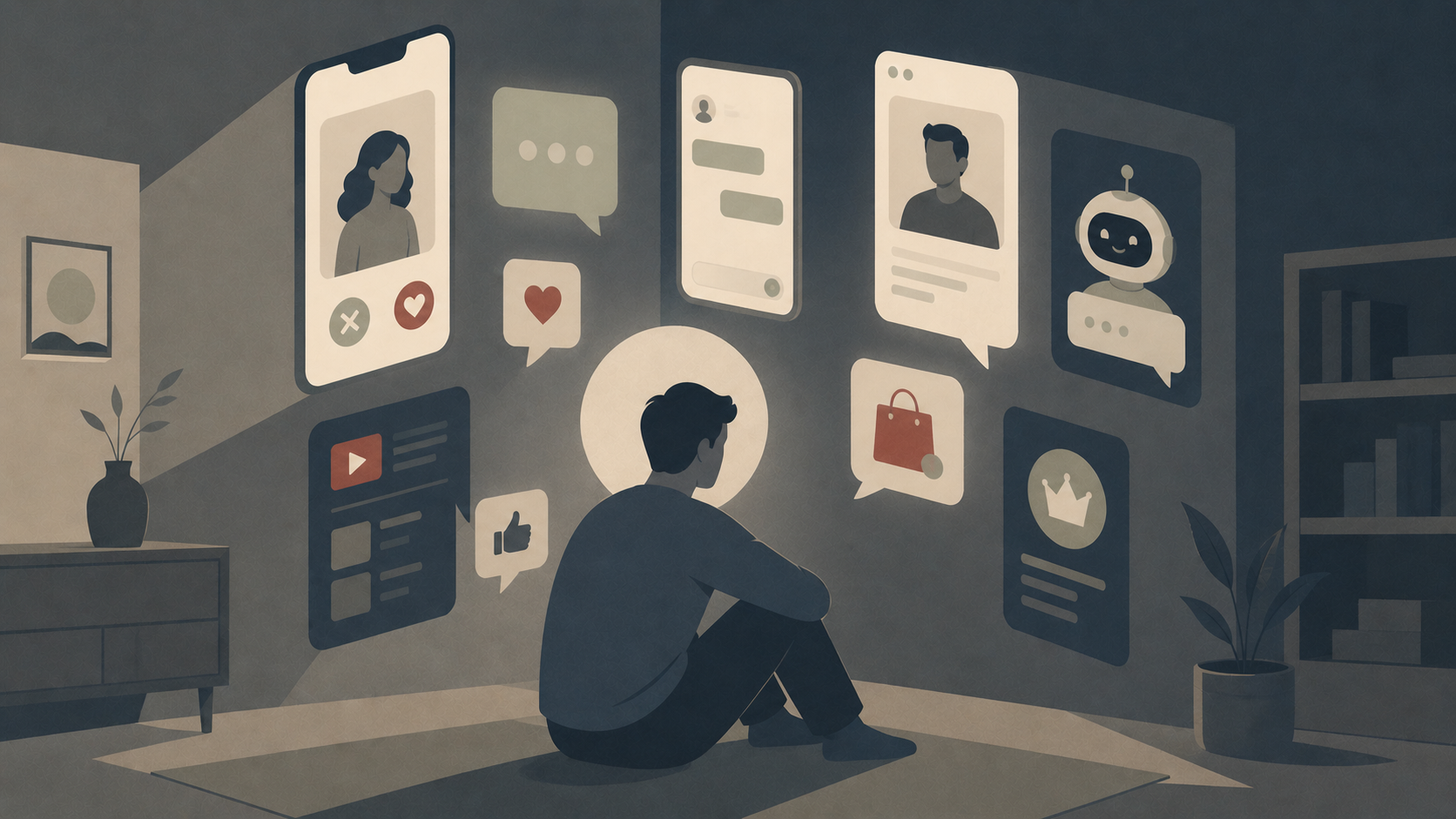
Loneliness is no longer outside the market
In When Connection Replaces Presence, the question was personal: what happens when the tools that help us reach each other also train us out of presence? This post moves from that personal problem to its economic extension. If digital life can weaken presence, the video They Need You Depressed and Single asks what happens when that weakness becomes profitable.
The video is not simply about loneliness as a feeling. It is about loneliness as a market condition. It argues that modern platforms have learned how to sell substitutes for intimacy: dating apps, AI companions, parasocial feeds, creator subscriptions, and algorithmic systems that keep people reaching for connection without necessarily helping them build it.
This article does not replace the video. It only frames the central idea: loneliness is no longer only something people experience privately. In the wrong system, it becomes something companies can organize, measure, and monetize.
The shift after 2012
The video places heavy weight on 2012, when smartphones and social media became embedded in everyday life, especially among young people. Around that period, researchers and public health observers began paying more attention to rising teen anxiety, depression, and isolation.
The causes are debated, and they should be. Loneliness is not produced by one device or one app. Housing, work, family structure, education, migration, inequality, and culture all matter. But the timing is difficult to ignore. As more life moved onto screens, many people became more reachable and less socially rooted.
Digital contact expanded. Embodied contact weakened.
A notification can interrupt loneliness for a moment. It cannot build trust, routine, shared memory, or the ordinary friction of being with other people. Those things require time, place, repetition, and vulnerability.
Thin connection is still thin
The modern loneliness economy works because it does not offer nothing. It offers something.
A dating app offers possibility. A creator offers attention. An AI companion offers response. A parasocial feed offers familiarity. A private message, paid reply, livestream, or personalized notification can feel like proof that someone is there.
Sometimes these substitutes genuinely help. An online community can support someone through a difficult period. A digital relationship can become a bridge toward real connection.
But a bridge is different from a permanent address.
When substitutes become the main form of intimacy, they can weaken the social muscles they promise to replace. The person receives signals of connection, but may lose practice in conflict, awkwardness, commitment, patience, and mutual care. Real relationships are not frictionless. They demand more than access.
The industries around isolation
The video’s strongest point is economic: loneliness creates demand.
Dating apps monetize the search for partnership. AI companions monetize simulated availability. Subscription platforms monetize attention, fantasy, and private access. Social platforms monetize time spent scrolling through other people’s lives. None of these markets need users to be deeply fulfilled. Many work better when desire remains unresolved.
That does not mean every company is consciously trying to make people lonely. The point is structural. A platform can profit from longing without causing it directly. It can identify the pain, package a response, and charge for continued access.
If loneliness is solved, the customer leaves. If loneliness is managed but not resolved, the customer returns.
That is the business model.
Loneliness has material causes
The loneliness economy does not exist only inside apps. It grows from the conditions around them.
Many young adults are financially delayed. Housing is expensive. Stable work is harder to secure. Living alone costs more. Family formation is postponed. Dating becomes more difficult when adulthood itself feels suspended.
This matters because loneliness is not just emotional. It is material. People need time, money, space, and stability to build relationships. If rent consumes the future, if work drains the day, if cities make casual gathering expensive, then apps become the easiest available interface for intimacy.
The app is not always the root problem. Sometimes it is the tool people reach for because the social world has become harder to enter.
The wider consequences
The video connects loneliness to fertility collapse, aging societies, care crises, and political radicalization. These links need care. Loneliness does not explain everything, and lonely people are not automatically extreme. But isolation changes what people are vulnerable to.
A lonely person may become more open to communities that offer certainty, enemies, identity, and belonging. Algorithms do not simply show content; they learn what keeps attention. If anger, resentment, humiliation, or grievance produces longer sessions, the feed can become a machine for emotional intensification.
Loneliness also touches demographics. South Korea’s low fertility rate is not caused by loneliness alone; it reflects housing costs, work culture, gender inequality, education pressure, and delayed partnership. But loneliness sits inside the same structure: weakened community and a growing gap between private desire and social possibility.
A society of isolated individuals has a harder time caring for the old, raising the young, sustaining trust, and passing responsibility across generations.
Governments are starting to notice
Loneliness is no longer being treated only as personal weakness. The United States Surgeon General issued an advisory on loneliness and social connection in 2023. Japan appointed a Minister of Loneliness in 2021 and later treated loneliness and isolation as national concerns.
That shift matters. It means loneliness is being recognized as something larger than mood. It affects health, work, family life, politics, and the basic ability of a society to reproduce trust.
But public recognition is not enough. A society cannot advisory its way out of loneliness while leaving the incentives untouched. If the market profits from isolation, then connection has to be rebuilt outside the logic of subscription, engagement, and endless personalization.
Watch the video
The business model of modern loneliness is not that companies offer help to lonely people. It is that loneliness keeps producing attention, payments, data, swipes, watch time, and dependency while ordinary connection becomes harder to practice.
This post only sketches the argument. The video develops it through examples, figures, and a wider economic frame. Watch Daniil Podtesov’s They Need You Depressed and Single here: