
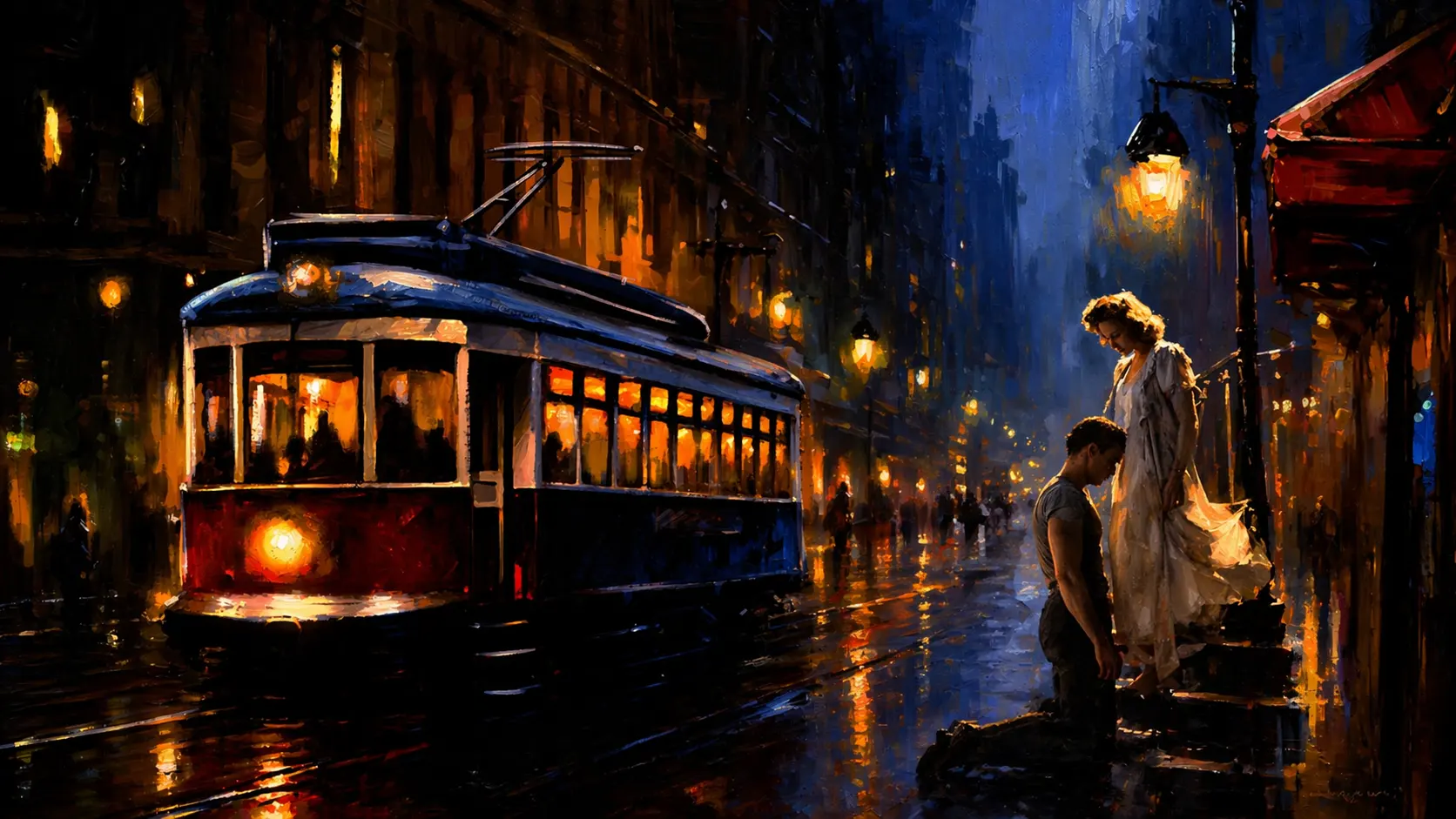
Blanche DuBois enters A Streetcar Named Desire already broken.
She does not arrive in New Orleans as a mystery waiting to be solved. She arrives as someone trying to survive the wreckage of a life that has already collapsed. Belle Reve is gone. Her husband is dead. Her reputation is ruined. Her body has become both refuge and evidence. Everything she tries to hide follows her into Stella’s home.
The play is not simply about desire. It is about what desire becomes when it is mixed with shame, loneliness, gender, violence, and the need to keep living after the self has been damaged.
Blanche does not use illusion because she is foolish. She uses it because reality has become unbearable.
Elysian Fields Is Not Paradise
The play opens in Elysian Fields, a name that suggests peace, beauty, and the afterlife. But Williams gives us something harsher: a working-class neighborhood marked by decay, noise, heat, and physical closeness.
Blanche is shocked by the place because it destroys the image she still carries of herself. She comes from the memory of Southern refinement, but she arrives in a world that has no patience for such performance.
Her first conflict is not with Stanley. It is with the space itself.
Elysian Fields exposes her. It strips away the fantasy of class, elegance, and control. The name promises paradise, but the setting gives her the opposite: a place where illusion cannot remain untouched for long.
Stanley’s World Is Built on Force
Stanley Kowalski is not just Blanche’s opposite. He is the force that makes her illusions impossible to maintain.
His power is physical, social, and sexual. He dominates the apartment, Stella, and eventually Blanche. His violence is not accidental. It is part of the atmosphere he creates around himself.
He beats Stella. He breaks things. He searches through Blanche’s belongings. He treats privacy as weakness and exposure as victory.
For Stanley, truth is not moral. It is a weapon.
That is why Blanche’s lies threaten him. Not because he values honesty, but because her performance challenges his control of the space. He must expose her because exposure is his form of power.
Blanche Bathes Because She Cannot Be Clean
Blanche’s repeated baths are not a simple habit. They are an attempt to wash away what cannot be washed away.
She bathes after tension. She bathes after confrontation. She bathes as if the body can be separated from memory.
Her past follows her through guilt, sex, death, and shame. The bath becomes a ritual of temporary escape. For a moment, she can imagine herself renewed, untouched, restored.
But the cleansing never lasts.
The problem is not dirt. The problem is abjection: the disgust, fear, and instability that threaten her sense of self. Blanche is trying to create a clean surface over a life she experiences as contaminated.
Gender Becomes a Wound
Blanche’s trauma is tied to the death of her young husband, Alan.
When she discovers his homosexuality, she reads it as a violation of the gender order she believes in. His softness, tenderness, and hidden desire disturb her because they break the fixed categories she has inherited.
Her cruel words, “You disgust me,” become part of the wound she carries after his suicide.
This moment matters because it shows that Blanche is not only harmed by desire. She is also harmed by the rules used to define acceptable desire.
The play’s world depends on rigid performances of masculinity and femininity. Stanley performs masculinity through force. Stella performs femininity through endurance. Blanche performs purity through fragility, manners, and seduction.
None of these performances saves them.
Seduction Is Not Freedom
Blanche’s seduction is often mistaken for appetite. But her behavior is less about freedom than survival.
She seeks attention from men because attention temporarily fills the void left by death, guilt, aging, and loneliness. Compliments reassure her. Flirtation gives her control. Desire allows her to feel visible.
But this visibility is dangerous.
To be desired in the world of the play is also to become vulnerable. Blanche tries to provoke desire while controlling its consequences. She wants admiration without exposure, intimacy without truth, rescue without surrender.
That contradiction destroys her.
Her flirtation with the young delivery man shows how deep this pattern runs. It is not love. It is not even simple lust. It is a momentary escape from disappearance.
Mitch Cannot Save Her
Mitch seems like a possible rescue. He is gentler than Stanley, lonelier, and more willing to believe Blanche’s performance.
But the relationship is built on need, not truth.
Blanche needs protection. Mitch needs replacement and comfort. Both are searching for something missing, but neither can fully see the other.
Once Mitch learns about Blanche’s past, his desire changes. The fragile courtship collapses. He no longer sees her as someone to marry, but as someone available to use.
The failure of this relationship confirms one of the play’s cruelest truths: Blanche’s fantasy of rescue depends on a purity she can no longer perform convincingly.
Desire and Death Travel Together
The title of the play turns Blanche’s life into a route: desire leads to cemeteries, then to Elysian Fields.
That sequence matters.
Desire in the play is not life’s opposite to death. It is often the road toward it. Blanche says death is the opposite of desire, but her own life suggests something more disturbing. Desire becomes her way of escaping death, while also carrying her toward another kind of death: social, psychological, and symbolic.
By the end, she is not physically dead, but she has been removed from the world. Her collapse is complete. The asylum becomes the final stop of a journey that began long before she arrived at Stella’s door.
Blanche’s Tragedy Is Not That She Lies
Blanche lies about her age, her past, her leave of absence, her drinking, and her desires. But the lies are not the deepest problem.
The deeper problem is that lying is the only structure she has left.
She builds herself out of shadows because direct light would destroy her. She hides behind manners, clothing, flirtation, and invented dignity because the truth offers no shelter.
Stanley destroys the lies, but he does not offer truth in their place. He offers domination.
That is why the play remains so disturbing. Blanche’s illusions are fragile and dishonest, but Stanley’s realism is brutal and empty. The collapse of illusion does not lead to justice. It leads to violence.