Discover why English rules the world not because it is simple, but due to centuries of empire, trade, and technological influence. From its “linguistic vacuum cleaner” history to its complex layers of vocabulary and irregular grammar, global English thrives on diversity, adaptation, and pragmatic flexibility. Learn how its vast lexicon, historical layers, and digital evolution shape international communication today.
The Paradox of Global English
From a strategic positioning standpoint, English operates not as a streamlined system of logic, but as a predatory linguistic vacuum. In global communications, a common but dangerous fallacy persists: that English achieved world dominance because it is "easy" or "simple." As a strategist, one must recognize that this dominance is a product of social and political history—of empire, geography, and technology—rather than linguistic economy. English is, in fact, famously irregular and vast.
To navigate this language, we must accept the "Two Great Truths" identified by David Crystal. First, a living language is in a constant state of flux; it changes even as a learner attempts to master it. Second, the version of a language found in a textbook is never the only version. Variation is the hallmark of a healthy language, and English varies more than most. This brief evaluates the historical "accidents" that created this complex global tool, arguing that its dominance is maintained despite its structural friction, not because of its simplicity.
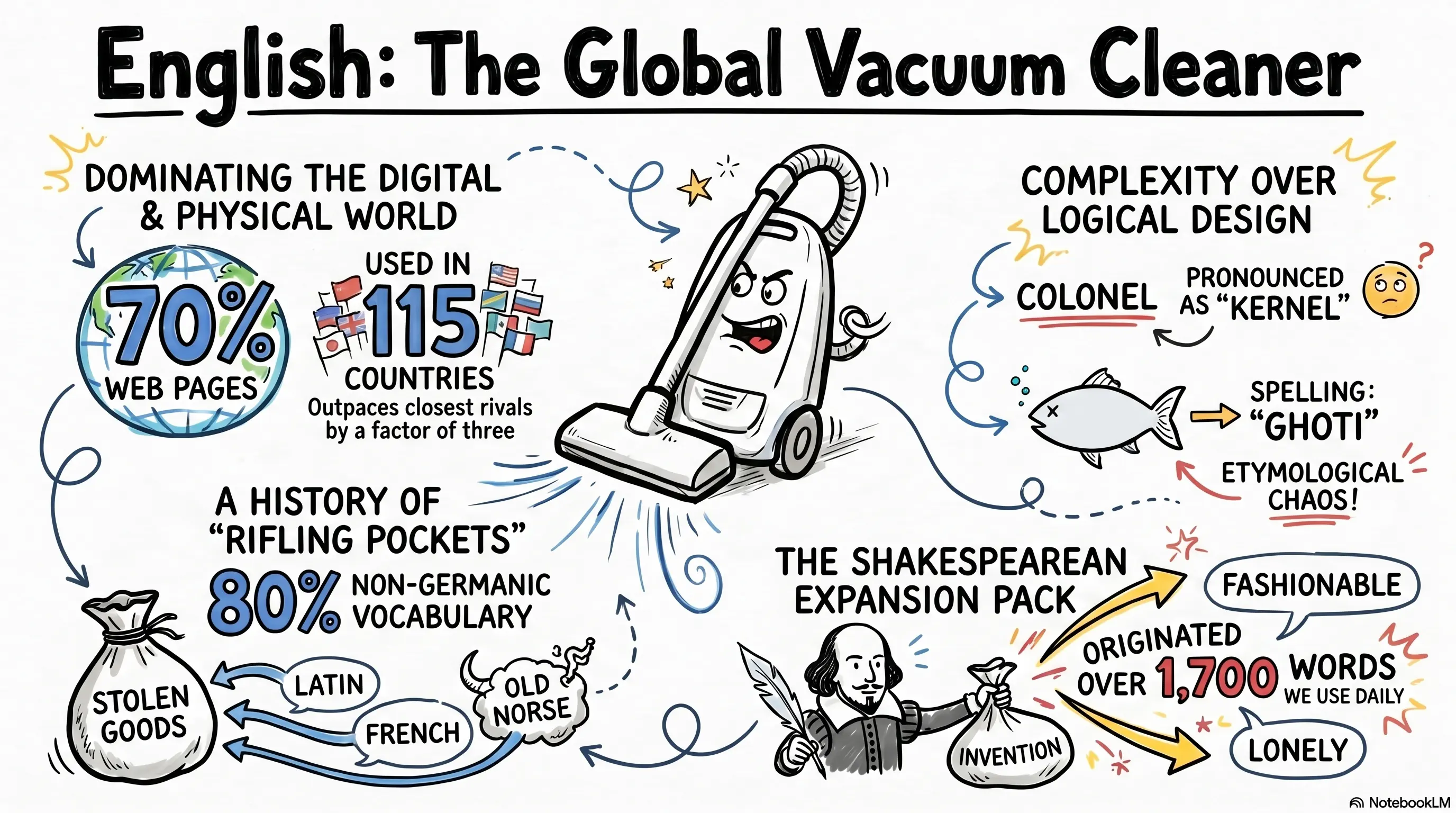
English: A Linguistic Vacuum Cleaner
The development of English is best understood through the metaphor of a "linguistic vacuum cleaner." Throughout its history, English has moved through the world, aggressively sucking up vocabulary from every culture it encountered through conquest and trade. This opportunistic growth has resulted in a language where roughly 80% of the vocabulary is non-Germanic, despite its Anglo-Saxon foundation.
This process of "lexical accretion" occurred in distinct historical waves:
The Germanic Foundation: While Anglo-Saxon provides the structural "glue," it was quickly supplemented by early Latin influences (e.g., butter, mile, street).
The Viking Incursions: The arrival of Old Norse in the 8th century eventually contributed fundamental terms like take, get, and egg.
The 1066 Pivot: The Norman Conquest installed French as the language of power, permanently altering the registers of law, architecture, and literature. Rather than replacing Old English, French terms often lived alongside them, creating a unique system of stylistic layers.
This layering created a language of "doublets" and "triplets," allowing speakers to choose between Germanic, French, or Latinate synonyms to convey specific social nuances.
Layers of English Vocabulary and Their Nuances
English vocabulary is layered, reflecting historical influences and connotations. Old English words are straightforward and practical, like “kingly” for sovereignty, “ask” for inquiry, “fire” for combustion, “house” for domicile, and “clothes” for raiment. These terms are familiar and direct. French-derived words introduce formality, like “royal” for sovereignty, “question” for inquiry, “flame” for combustion, “mansion” for domicile, and “attire” for raiment. These words are used in sophisticated contexts. Latin words provide precision, like “regal” for sovereignty, “interrogate” for inquiry, “conflagration” for combustion, “residence” for domicile, and the absence of a Latin equivalent for “raiment” highlighting its specialized use. The choice of vocabulary in English depends on the desired tone and context, with each layer offering distinct nuances and levels of formality.
The Expanding Challenges of the English Lexicon
The sheer vastness of the English lexicon creates a strategic hurdle: nobody actually knows how many words the language contains. While the Oxford English Dictionary lists over 600,000 entries, it cannot account for the infinite expansion occurring at the fringes of technical and global English.
The sources of this "lexical bloat" are strategically significant:
- Scientific Innovation: As academics innovate, they devise unquantifiable new designations. For example, there are millions of identified insects, each requiring entomological terminology.
- Compound Idiosyncrasies: English allows for infinite word formation. Compounds like "heart-friendly," "mould-prone climate," or "red-wine-is-best theory" are intelligible and widely used, yet they rarely appear in formal dictionaries.
- Global Adaptation: "New Englishes" add thousands of regionalisms. The Dictionary of Caribbean English contains over 20,000 entries unique to that region's social structure.
For the global strategist, managing the "active" vs. "passive" vocabulary gap is a matter of risk management to avoid alienating audiences:
- Passive Vocabulary: The words understood when reading or listening. Educated native speakers and fluent second-language learners typically range between 40,000 and 50,000 words.
- Active Vocabulary: The words actually used in speech or writing. This is generally about one-third lower than the passive count.
Stylistic quirks of English grammar
English grammar is riddled with "why-questions" that reveal a system governed by stylistic conditioning rather than logic.
- The Article Anomaly: While nouns like "knowledge" are taught as uncountable, they shift into countable status through modification, such as having "a good knowledge" of a subject.
- The Proper Noun Shift: Common nouns like "Baby" or "Teacher" are often used without articles, effectively becoming substitutes for proper names. Strategically, this can be "communal" and friendly, but as Crystal notes, it can also be "patronizing or demeaning," as seen in a Sergeant’s sarcastic "Tell Sergeant all about it."
- The "Amn't I" Gap: English contains glaring morphological gaps. The logical "amn't I" exists in some dialects but was replaced in Standard English by the irregular "aren't I," a replacement that makes little grammatical sense.
- Prescriptive Superstitions: Many "rules" are 19th-century bans. Teachers once forbade starting sentences with "And" or "But" to prevent children from overusing spoken narrative styles. However, writers like Jane Austen and J.R.R. Tolkien used them to provide a "dynamic punch."
The Creative Tension Between English Speech and Writing
The gap between spoken and written English creates significant strategic frustration. Much of this is driven by euphony—the search for better rhythm or the avoidance of clashing consonants. This is evident in suffixation dilemmas, such as choosing between "geographic contours" and "geographical contours."
The suffix "-ish" has evolved into a mindset. We add it to everything from colors to hours (sevenish) and even long adjectives (extraordinary-ish). This "Ish-ly" mindset, popularized in the work of Peter H. Reynolds, suggests a creative spirit where "getting it right" is less important than the expression itself. While this allows for flexibility, the underlying "orthographic chaos"—including the erratic use of the apostrophe and the -ise/-ize variation—remains a barrier to standardization. These irregularities are the "price of admission" for a language with such a volatile social history.
The "So What?" Layer: Power over Simplicity
English is world-dominant despite its complexity. Its position is maintained by historical power and modern pragmatic flexibility.
- Social and Political History: The legacy of the British Empire and American "soft power" spread once-literal or pidgin expressions into global standards. "You're welcome" (a polite response to gratitude) and "Long time no see" (likely a contact-language expression spread via cinema) are now universal.
- Digital Manifestation: The internet acts as a catalyst for "accommodation." Participants in digital spaces encounter "worldwide lexical variety," where different dialects and levels of competence influence one another in real-time. The "Vacuum Cleaner" of the 11th century has been replaced by the "Digital Accommodation" of the 21st.
- Pragmatic Flexibility: English uses "Tautology" (saying the same thing twice) to convey sophisticated meaning. Phrases like "It is what it is" or "It takes what it takes" function as an avoidance strategy to halt a dialogue or an assertive strategy to signal that no further detail will be provided. This is a vital tool in high-stakes negotiation.
Ultimately, the global status of English is a "historical accident" of power, geography, and technology. It is a language that has grown by inclusion, resulting in a tool that is brilliantly flexible, frustratingly complex, and undeniably dominant.